Learn to Code with Sports
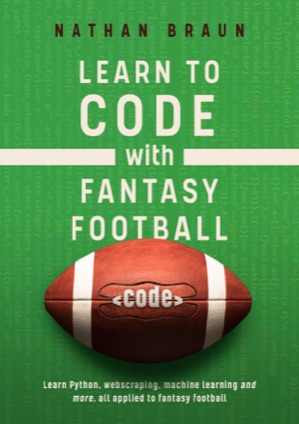
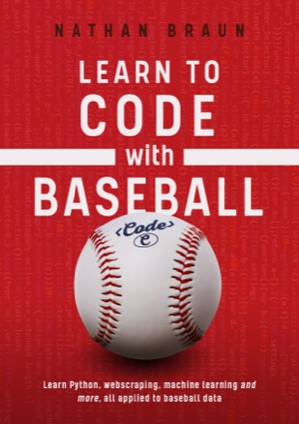
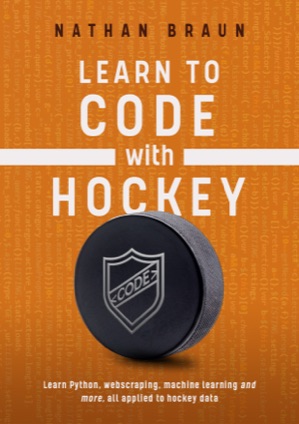
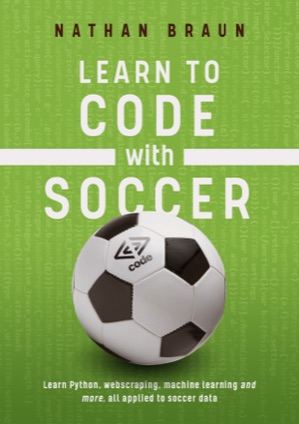
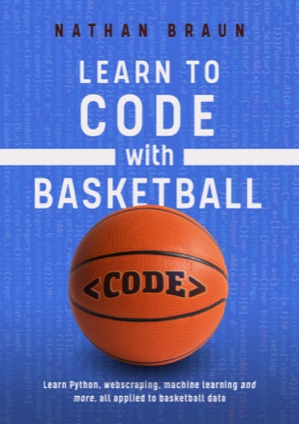
Learn to Code with Fantasy Football, Baseball, Hockey, Soccer, and Basketball are a series of books I wrote between 2019 and 2022. I followed it up with a book on AI and tooling in 2024.
The story, at a very high level:
- I wrote and self published the first one in 2019 while working 80% at my day job.
- I quit my job and created four other versions.
- Sold more than $1M.
- Built a 70k person email list.
- Watched AI make the books obsolete.
- Eventually released them for free.
Contents
All the books covered basically the same thing: Python, Pandas (Python’s main data analysis library), SQL, web scraping, public APIs, data visualization, summary stats and modeling, all applied to sports and sports data.
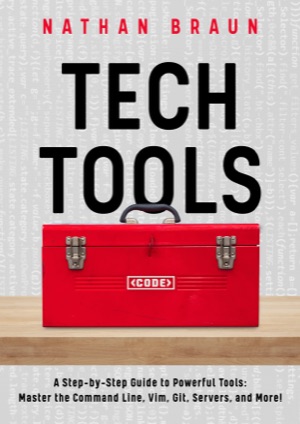
I also wrote a tooling based companion book (Tech Tools) which covers the terminal, Vim, Git, servers (and later AI tools like Claude Code).
Background
I had been building side projects and playing around with selling products (and earlier consulting) on nights and weekends since grad school. Once we had our second kid in 2018 night and weekend time got pretty scarce.
Around that time I also read Principles by Ray Dalio, which I’ve talked about elsewhere. It’s not magic, or nec anything that different from common sense, but clicked with me.
Three relevant parts:
5 step process to get what you want out of life
First was Dalio’s 5 step process, which is:
- have clear goals
- identify, and don’t tolerate problems that stand in your way
- accurately diagnose problems to get at root cause
- design plans that will get you around them
- do what’s necessary to push designs through to results
I went through this exercise with the goal “work for myself” and decided the root cause was I a) didn’t have enough products available for people to buy and b) going down a level, I didn’t have a ton of time to work on them. Separately, I had a tendancy to build vs thinking about distribution or ‘just shipping’.
(Note I still find this process valuable, and created a Claude skill for it.)
Designer vs worker level you
The second part of Principles I really liked was Dalio’s idea re: designer vs worker level you.
He recommends thinking of yourself as a worker operating in a machine that you’ve designed, and says it’s important to distinguish between you as the designer of your machine, and you as a worker within your machine.
“It’s much more important that you are a good designer/manager of your life than a good worker in it.”
So, in what I viewed as a ‘designer of my life’ move, I decided to go down to 80% at my day job in order to work on my own stuff/work for myself.
My plan was to start with the coding books and move on to something else if that didn’t work.
(Note for those counting that’s two Dalio inspired lessons, the third is the navigating levels part below.)
Audience
The main target for the books ended up being people who are:
- into sports data
- have done a bit of their own analysis in something like Excel
- don’t necessarily have much background in coding
- are interested in learning more
- unsure where to start
Which was basically me in ~2013 ish.
The books are based on the assumption (and my experience) that data science type tasks are pretty universal across domains. Once you learn how to query a database or scrape some data or spin up a regression model in one domain, it’s straightforward to apply it to others.
They were definitely more about teaching these concepts than getting into advanced analytics or stats. It wasn’t like if you read it you’d be able to go work for the Brewers or something. Though these coding skills would also prob be prerequisites, and did have readers from the industry too.
Writing Process and Experience
Writing the book wasn’t that difficult. That’s probably mainly due to the topic — I’d spent a lot of time thinking about fantasy football and a lot of time doing data science type tasks at my day job — but I also read a lot and am decent at writing.
I also enjoy teaching and believe I’m pretty good at:
- synthesizing/summarizing and finding themes/commonalities among large amounts of information
- picking out a path to knowledge and introducing things at the right time
- getting in the mind of the reader and finding and avoiding potentially confusing spots they might trip up on
At first I tried to write in prose form, but found that was way too slow, mostly because it was too hard to keep from trying to edit/rewrite/make perfect sentences as I went.
It was much easier for me to write out bullet points of the concepts I wanted to get across, even down to the sentence level (I do these writeups on my site the same way).
So I bulleted out the whole book, then rewrote it as prose.
Navigating Levels
Another Dalio concept I often thought about while writing and bullet pointing was the idea of levels.
Reality exists at different levels and each of them gives you different but valuable perspectives. … We are constantly seeing things at different levels and navigating between them, whether we know it or not, whether we do it well or not… For example, you can navigate levels to move from your values to what you do to realize them on a day-to-day basis.
> I want meaningful work that’s full of learning.
>> I want to be a doctor.
>>> I need to go to medical school.
>>>> I need to get good grades in the sciences.
>>>>> I need to stay home tonight and study.
When a line of reason has gotten jumbled, it’s often because the speaker is jumping around different levels without showing how they connect.
That’s why, when conveying information, it’s important to:
- Be aware what level you’re examining a given subject.
- Consciously navigate levels rather than see subjects as undifferentiated piles of facts that can be browsed randomly.
Of course, I had always known that in theory, but explicitly keeping it in mind made the book better and led to reactions like these:
“Your ability to look at complex things and break them down into their simple parts in real time is rare.” — Taiwo M
“Wow. Nice work — I mean that. As a former teacher and once-upon-a-time coder, I really appreciate how you go about this.” — Matt W
Growth
I wrote football in 2019 on my one day off a week. I wanted to focus on distribution from the beginning, and spun up a waiting list first. Reception (mostly via Reddit) was positive, and I had a couple of thousand people on it. Initially I sold to that.
It was nice, but not really needle moving in terms of income. Actually, I specifically remember talking to a friend, who said, “it’s cool you made 30k or whatever, but it’s not like you’re going to quit your job”.
As it turns out, 30k for 20% of my time did beat my then day-job salary, and was helpful in making the leap to working on my own things full time (it was also nice my wife had a good job).
But it’s true that at that point I didn’t necessarily see it getting much bigger, except maybe linearly by doing the same reddit -> waitlist playbook for other sports.
What changed that was facebook/instagram ads. How they work:
- you upload, say 3k email addresses of book customers to Meta
- Meta (automatically) matches those with Facebook/Instagram profiles
- Meta then (again, automatically) builds a model: “we used all our internal Meta data to build a model and rate everyone on Facebook/Instagram in terms of how similar they are to the people who bought your book, 0-100”
- “here’s 5M 100’s”
This is when sales really took off. I initially played around with small amounts of ad spend, then hired someone to manage it. The person I hired mainly helped by dramatically increasing the spend. That ended up working (and was a lesson in itself). I eventually managed all the ads (from creating visuals in Canva to coding up the attribution plumbing and managing the lookalike audiences) myself.
Email drip
Part way through also started offering a truncated preview to anyone who entered their email. I’m glad I did; have something like ~70k emails now.
I followed the free preview request up with a basic drip campaign. My most interesting email maybe was an explanation of the Monty Hall problem, which I sent in order to prove I was a good teacher (note I still do think it’s a good explanation).
“Can I just say that this is the simplest and best explanation I have ever seen… Awesome!!” - Stu T
Results
Initially I priced Learn to Code with Fantasy Football at $45 and sold it on Gumroad. Later I moved to Sendowl and gradually raised the price to $79, $119 with a bundle.
I briefly thought about releasing a physical copy on Amazon, but I didn’t necessarily think people would be willing to spend as much for non-textbook physical books + it was helpful to have in digital form so you could have it up in one monitor while you coded alongside it in another.
Both sales and reception were good (related obviously) — I sold more than $1M worth of books, and kept track of the feedback (all of it basically unsolicited; I didn’t have a big testimonial collection operation or anything).
“The book here was really, really well done.” — Bill Connelly, ESPN
“It helped me way more than my grad school class did.” — Glen I
“The way the learning is framed here is 10x what you’ll get someplace else.” — u/Nick58
You can see some more here.
Follow up books
In addition to the 5 main sports, I also did an annual “fantasy football dev kit” where we’d walk through building ‘real life’ projects using a projection/simulation API I’d built.
The developer kit included access to the API for one year. It was my first real foray into recurring revenue, which was nice. It mostly functioned as an upsell/higher priced offering to Learn to Code with Fantasy Football, which was fine.
I also wrote a book on tooling. For the coding books, I did a simple setup to get people up and running ASAP. That was good for learning and let people focus on one thing at a time, but wasn’t actually how I coded.
So wrote all that down in ‘Tech Tools’, and people could start either with that or the coding books. Again, I think it mostly worked as an upsell; it doesn’t have the same, “take my money” appeal as Learn to Code with Sports.
But it was still valuable, and I did have people go through it and really like it. Ironically, it’s much more relevant now that AI writes most of the code.
AI and the fall of the books
I’ve been using AI coding tools since soon after they were invented (basically just fancy autocomplete).
I was working on the first edition of tech tools when early AI was out. It was very helpful in setting up configs etc. But was definitely hit or miss and couldn’t reliably one shot code yet.
Still, I did see how AI was getting better and where things were going.
At first (~2023-2024) my thinking was, “wow AI is getting good, I could see it changing how people learn to code — it’s probably going to have implications for my books”.
Then (late 2025, early 2026) it moved to, “wow AI is getting really good, I’m not even sure people are going to have to write code anymore”. Which is basically what happened.
This all showed up as a decline in sales, and in early 2026 I stopped ad spend completely.
I was still selling some copies, which I had mixed thoughts on. Part of me felt like I was selling flip phones to people in 2012. But at same time, I am a better user of AI because I know how to code.
Was learning to code, and then learning about AI necessarily the best/most efficient way to go about things? Prob not. But — just like smart phones probably >> flip phones (per revealed preference), there are tradeoffs to smart phones. I felt like it was something for people to discover on their own timelines.
But eventually (with Claude Code etc) I basically came to the conclusion that coding the old way is “solved”. It was pretty clear the books were no longer relevant as the most efficient way to learn for most people.
So I made them free. People still are downloading them. It could be a good move for some people, depends on how much time you have.
What I took from the books
I’m proud of these books. They combined my interests (tech, sports) and skills in a way that worked given the constraints I had. It was fun to go to ‘work’ every day. I think they were a genuinely good. I heard from people it helped get jobs, and others who finally ‘got coding’ after struggling with it for a while.
It also helped with confidence in my own skills and judgement. I taught myself to code, and a lot of resources were confusing or presented in weird order. I thought it could be done better, so I did it. Based on reception and market reaction, it worked out.
The whole project should also be helpful for future pattern matchin. For example, product market fit. There’s a quote from Patrick McKenzie:
“With product market fit, you know it if you have it; if you’re not sure, you don’t.” - Patio11
The books definitely had it, and right away — I didn’t have to do a bunch of thrashing or pivoting to find it. That won’t always be the case, but I think it’ll make me more effective having experienced it.
Inside view of AI/trends
From 2023-2026, I watched AI go from smart autocomplete to good but buggy code to basically superhuman. I used an early “talk to LLM’s in Vim” plugin, used that to build my own, “talk to LLM’s in Neovim” plugin, used that to get AI to write a bunch of code I’d have to test/compile by hand. Eventually I moved to Claude Code which did all that and more.
I also feel like hobby/passion projects (e.g. with sports) gave me a good, up close view to cutting edge tech. For example, in 2019 when I posted on r/fantasyfootball there was a huge response, right away. Now people build way more polished (and free) stuff with AI, and no one blinks.
I think this perspective might be useful in areas where AI is diffusing more slowly, e.g. non-consumer/hobby products or messier b2b/physical world stuff. Industries where people aren’t coding up really polished products on their own dime on nights and weekends.
That’s why I’m trying to learn and get more exposure to these areas now. If you’d like to talk, please don’t hesitate to reach out.